Monday, March 26, 2012

1.36

________________________________________

1.36

15 March 2012

10:27
· 1.36 understand that:
· the universe is a large collection of billions of galaxies
· a galaxy is a large collection of billions of stars
· our solar system is in the Milky Way galaxy
[cid:image001.png@01CD0B2F.897AFE80]

Comparative sizes of planets and stars

[cid:image002.jpg@01CD0B2F.897AFE80]

Comparative sizes of galaxies

[cid:image003.png@01CD0B2F.897AFE80]

Powers of 10 - Cosmic Voyage

[cid:image004.png@01CD0B2F.897AFE80]

1.36 Space is big! Scale model of the solar system

12 May 2011

14:47
· Type the length of your classroom into cell B5 to get the solar system scaled to fit!
· Check out column U for information about the nearest star to our solar system!

>

Online version

http://www.exploratorium.edu/ronh/solar_system/

1.36 Plenary Answers

15 March 2012

10:30
1. What is the solar system?

Everything that orbits our local star, the Sun
2. What is the Milky Way?

The galaxy that contains our solar system
3. What is a galaxy?

A huge collection of billions of stars
4. How many galaxies are there in the Universe?

Billions

scale model.xls Download this file

1.35

________________________________________


1.35

15 March 2012

10:26
• 1.35 use the relationship between orbital speed, orbital radius and time period:

orbital speed = 2×Π×orbital radius

time period

v = 2×Π×r

T

v = 2×Π×r

T

v = orbital speed (m/s or km/hr)

r = orbital radius (m or km)

T = orbital period (s or hr)

1.35 Plenary Answers

15 March 2012

10:30

Pearson Answers, p.56, Q3+4

[cid:image001.png@01CD0B2F.985729B0]

[cid:image002.png@01CD0B2F.985729B0]

[cid:image003.png@01CD0B2F.985729B0]

[cid:image004.jpg@01CD0B2F.985729B0]

1.33

________________________________________

1.33

15 March 2012

10:25
· 1.33 explain that gravitational force
· causes moons to orbit planets
· causes the planets to orbit the sun
· causes artificial satellites to orbit the Earth
· causes comets to orbit the sun
>

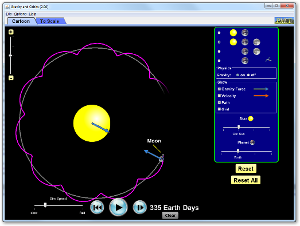
http://phet.colorado.edu/en/simulation/gravity-and-orbits


1. Turn on

[cid:image001.png@01CD0B2F.820FE2A0]
2. Experiment with the 4 different situations to see what orbits what and why

[cid:image002.png@01CD0B2F.820FE2A0]
3. Still not sure? Try

[cid:image003.png@01CD0B2F.820FE2A0]

PhET animation - gravity and orbits

31 January 2012

13:34
>

Website

http://phet.colorado.edu/en/simulation/gravity-and-orbits

Embed code for your blog

Gravity and Orbits

Click to Run

1.32 and 1.34

________________________________________

1.32 and 1.34 Starter

16 March 2012

10:18

Tell the person next to you…
· the names of the 8 planets in our solar system (in order!)

Answers
1. Mercury (closest to the sun)
2. Venus
3. Earth
4. Mars
5. Jupiter
6. Saturn
7. Uranus
8. Neptune (furthest from the sun)

How can you remember this?
· "My Very Educated Mother Just Served Us Nothing"
· "My Very Easy Method Just Speeds Up Naming (Planets)"

[cid:image001.jpg@01CD0B2F.7607BF00]

1.32 and 1.34 Starter 2 - Quick Planets quiz

12 May 2011

15:52
>

1.32 and 1.34 Investigating the solar system - answers

16 March 2012

10:26

Moons
1. How are moons different from planets?

Planets orbit the Sun; moons orbit planets
2. The Earth has one moon. Do all planets?

No. Mercury and Venus have no moon, Mars has 2 and Venus and Saturn both have over 60 each!
3. Do moons have gravitational fields?

Yes, any body that has mass generates a gravitational field. The gravitational field strength on our Moon is

1.62N/kg, which is about 1/6 of the gravitational field strength on Earth.

Gravitational fields
4. Which planet has the largest gravitational field? What is it?

Jupiter = 26N/kg
5. Which planet has the smallest gravitational field? What is it?

Mercury = 4N/kg (Pluto doesn't count! See Q.11)
6. What is the relationship between the mass of the planet and the gravitational field strength of the planet?

The larger the mass of a planet, the stronger the gravitational field strength

Period of orbit
7. Which planet has the shortest period of orbit? What is it?

Mercury = 3 x Earth month = 0.25 x Earth year

(if you lived on Mercury you would be over 60 years old!)
8. Which planet has the longest period of orbit? What is it?

Neptune = 1978 x Earth month = 164 x Earth year

(if you lived on Neptune you would be 0.1 years old!)
9. What is the relationship between the period of orbit of a planet and its distance from the Sun?

The larger the distance from the Sun, the greater the period of orbit
10. What is the relationship between the surface temperature of a planet and its distance from the Sun?

The larger the distance from the Sun, the lower the surface temperature

(the one exception to this rule is Venus which has an exceptionally high surface temperature of +465oC due to an atmosphere of 96% CO2 and clouds of H2SO4!)

Classification of astronomical bodies
11. What 2 classifications are the planets grouped into? What are the key features of each group?

4 Inner "rocky" planets
o Rocky
o Smaller diameters
o Shorter periods

4 Outer "gas giant" planets
o Gaseous
o Larger diameters
o Longer periods
o Have rings (most noticeable for Saturn, but they all have them)
o What are 2 key features of comets and 3 key features of their orbits?
i. Made from ice and dust
ii. Have a tail when they pass close to the Sun
i. Highly elliptical orbit - see blue trace.

[cid:image002.jpg@01CD0B2F.7607BF00]
o Sometimes pass close to the Sun at very high speeds but spend most of their orbit in the outer reaches of the solar system moving at much lower speeds
iii. Periods can be from a few years to hundreds of thousands of years
13. How do the orbits of asteroids differ from the orbits of comets?

Asteroids are lumps of rock that mostly orbit the Sun in the "Asteroid Belt", between Mars and Jupiter, in approximately circular orbits
14. Which planet in the animation is no longer a planet? (it has been reclassified as a planetoid or dwarf planet)

Pluto was reclassified as a planetoid or dwarf in 2006 for reasons including its highly elliptical and tilted orbit

PhET animation - my solar system

31 January 2012

13:34
>

Website

http://phet.colorado.edu/en/simulation/my-solar-system

Embed code for your blog

planets quiz.swf Download this file

Friday, March 23, 2012

1.24

________________________________________


1.24 starter

14 March 2012

16:55
>
· Can you explain this in terms of the Principle of Conservation of Momentum?

1.24

Tuesday, July 06, 2010

3:04 PM
· 1.24 demonstrate an understanding of Newton’s third law
[cid:image001.png@01CD05AD.22C158B0]
>
>

Newton's 1,2,3 summary.swf Download this file

N3 pairs.swf Download this file

N3 guy jumps off boat.swf Download this file

Image001

1.23 Plenary answers

Image001

1.23

________________________________________

1.23 starter

14 March 2012

16:23
· Why does kicking a brick hurt your foot?
· Why does kicking a football not hurt your foot?
>

1.23

Tuesday, July 06, 2010

3:04 PM
· 1.23 use the relationship between force, change in momentum and time taken:

force = change in momentum

time taken

F = Δp / t

From N2L F = m x a

but a = v - u / t

so F = m (v - u) / t

F = mv - mu / t

but p = mv

so F = pf - pi / t

F = Δp / t

can be written as Δp = F x t = Impulse

We can express the green equation in words as...

"Force is the rate of change of momentum"

How to catch a high velocity egg!

Example 1

Why would you prefer to fall onto a bed than onto concrete? (3 marks)

Answer
· Concrete or soft bed, your change in momentum is equal
· With a soft bed, this change in momentum takes place over a longer time
· This means that the force needed to change your momentum is less

or use the equation
· Impulse = Δp = F x t where Δp = constant
· soft bed => increases t
· and therefore decreases F

Example 2 - Pearson, p.41

[cid:image001.jpg@01CD05A9.D9A789E0]

Answer

F = Δp / t

10,000 = Δp / 60

Δp = 600,000kgm/s

Δp = mv - mu

Δp = m(v - u)

600,000 = 1,200(v - 2000)

v - 2000 = 500

v = 2500m/s

Impulse - kicking a ball and kicking a brick.swf Download this file

Image001